During the processes of wood processing, furniture manufacturing, or architectural decoration, a large amount of offcuts, irregular wood, or "waste wood" is always produced. How to efficiently convert these waste woods into daily necessities with stable market demand and considerable added value - toothpicks? Today, we will share the process based on a customer's case.
Not all waste wood is suitable for making toothpicks. The ideal wood should have the characteristics of fine texture, not easy to split, no odor, and moderate hardness. Samán wood is an excellent reference case:
Physical properties: The air-dry density is between 0.53-0.60g/cm³, and the Janka hardness is 900-1030lbf, which means it has sufficient toughness and is not too hard to cause processing difficulties or damage to the gums during use.
Moisture content: Keeping it around 12% is crucial, which ensures the stability of the wood during processing and use and prevents deformation.
Applicability: Its hardness is close to that of black walnut, and the density is moderate, making it very suitable for processing into toothpicks, barbecue skewers, and other small, fine wood products.
Selection suggestions: Prioritize hard wood offcuts without rot or insect damage and with relatively straight grain. Soft wood (such as pine) is usually not the first choice because the toothpicks made from it are prone to breakage due to its soft texture.
The most important step in converting waste wood into toothpicks is to cut the various lengths and thicknesses of waste wood into uniform wood strips. Here, we share two applicable sawing machines:
|
Simple manual method |
Simple Single-Machine Circular Saw Machine |
Manual advancement of sheet materials, with piecewise sawing. Highly flexible, capable of handling irregular timber materials.。 |
3KW |
Small-scale trial production, family workshops, and scenarios with highly irregular wood specifications。 |
Approximately $1,260 |
|
semi-automatic scheme |
Multi-blade saw (250mm feed model) |
Single-pass sawing produces multiple pieces of square material directly for use by the chipper, significantly improving efficiency. |
12KW |
Small factories with medium-scale production, relatively uniform wood specifications, and a focus on efficiency. |
Approximately $3,980 |
|
Fully automated production line |
A combination of wood chipper, round rod machine, sharpening machine, and packaging machine. |
The entire process automation from wood chips to finished toothpicks ensures high production volume and stable quality. |
combined power |
Large-scale, standardized production enterprises. |
Customize based on configuration |
Initial verification: If you are just starting to explore, you can choose a simple single circular saw machine for trial production. It has a small investment, is easy to operate, and can quickly verify the feasibility of processing waste wood and market demand.
Large-scale production: Once the demand is stable, upgrade to a multi-blade saw. Its feature of "producing square wood in one go" can significantly reduce labor costs and improve production efficiency, making it a powerful tool for processing hard wood (such as Samán).
Process connection: The width of the square wood sawn by the multi-blade saw should be controlled at ≤60mm (the common toothpick feed width is about 45mm) to be compatible with the subsequent slicing machine or round bar machine.
Combining traditional techniques with modern equipment, we have sorted out a clear production line for you:
Sawing machine - Slicing machine - Wire drawing forming machine - Precision cutting machine - Polishing machine - Sharpening machine - Single toothpick packaging machine
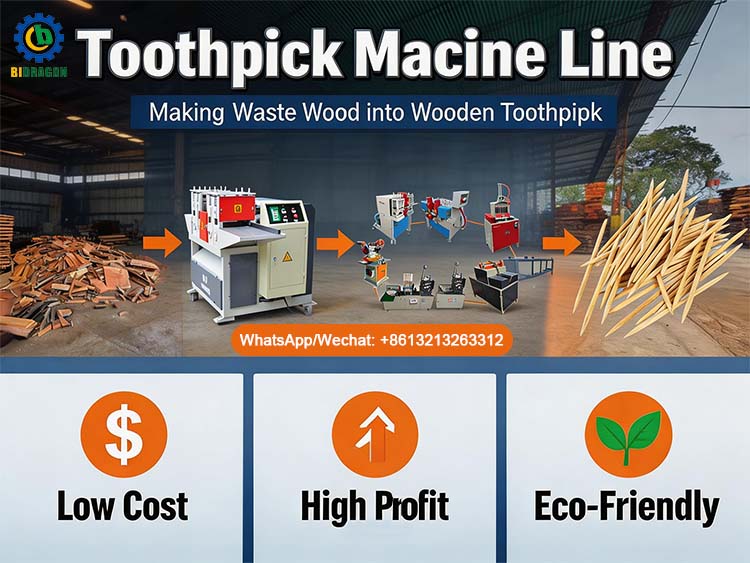
Raw material processing and cutting: Preliminarily sort the recycled waste wood and remove impurities. For larger wood pieces, perform rough sawing first. 2. Slicing and Cutting: Use a circular saw (single or multiple blades) to process irregular waste wood into square pieces with uniform thickness and width meeting the requirements (such as ≤ 60mm). This is a crucial step in converting "waste" into "standard" materials.
Shaping: Send the square pieces into a round bar machine to process them into round wires with a diameter of about 2-3mm. This step transforms the square pieces into the initial form of toothpicks.
Sharpening and Polishing: The round wires enter a sharpening machine to form the pointed end of the toothpicks. Then, surface polishing is carried out to remove burrs and ensure safety during use.
Disinfection and Packaging: The formed toothpicks need to undergo high-temperature drying or chemical disinfection to ensure hygiene. Finally, they are packaged automatically or semi-automatically.
Key Points of the Process: For harder woods (such as Samán), the sawing effect of a multi-blade circular saw is better when the "width > thickness". If the wood width is less than the thickness, usually "slicing out pieces of 10mm or more" can meet the subsequent processing requirements.





