Globally, over 40 billion sets of disposable plastic cutlery are consumed annually, and these disposable forks and spoons take hundreds of years to decompose. In recent years, with the enactment of plastic bans in various countries, all industries using disposable tableware have faced the challenge of choosing environmentally friendly alternatives. However, there are too many disposable tableware products labeled "eco-friendly," sold mixed together from wood, bamboo, and sugarcane bagasse, with significant price differences, leaving customers unsure of which to choose.
As a purchaser of disposable tableware, what points should we pay attention to? This article provides the answers.
There are several types of raw material for the wooden cutlery. Such as Birch, poplar, linden, and so on. While in the actual application, we need to consider the durability, and prices. Below is a simple explanation of the differences between each type of wood to help you choose according to your needs.
Birch: The primary raw material for disposable wooden tableware. It has a fine grain, is not easily damaged by moisture, and has suitable hardness.
Poplar: Lighter and cheaper, offering excellent value. It can also be used as a backup material for disposable wooden tableware, but its hardness is not as good as birch.
Linden: Very smooth surface, delicate to the touch, without rough splinters. It can be used when birch and poplar are unavailable, but its quality is not as good as linden and poplar.
The production process of disposable wooden tableware is simple: First, the logs are rotary-cut into thin veneers, then punched into shape using a die-cutting machine. After drying, the edges are chamfered, polished, and all burrs are removed, making the tableware smoother, waterproof, moisture-proof, and cleaner and safer to use.
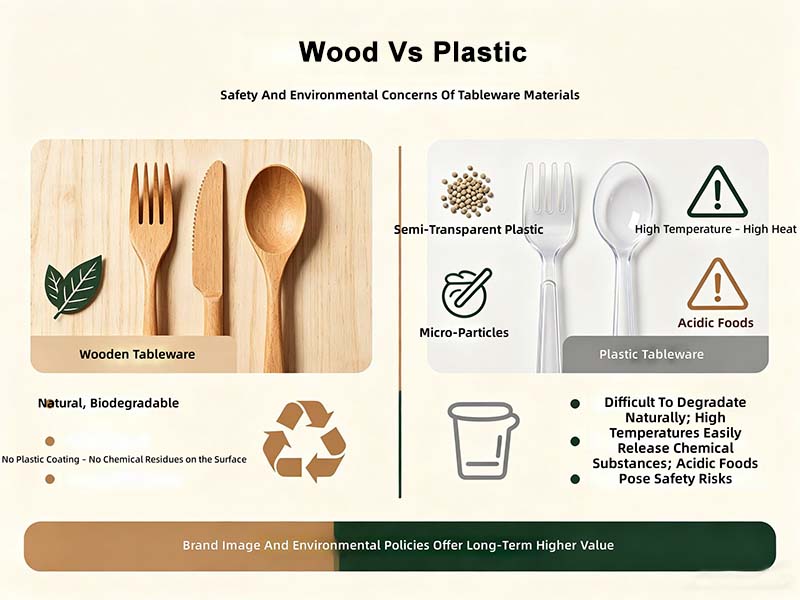
Wood vs Plastic
Plastic cutlery is not biodegradable after use. It is prone to leach chemicals when exposed to high temperatures or acidic foods. Wood cutlery is naturally biodegradable and does not have plastic coatings, so there are no chemical residues on the surface. The safety of the food it contains is also more reassuring. Although wooden cutlery is more expensive than plastic cutlery, it can save costs for customers in terms of brand image and environmental policies.
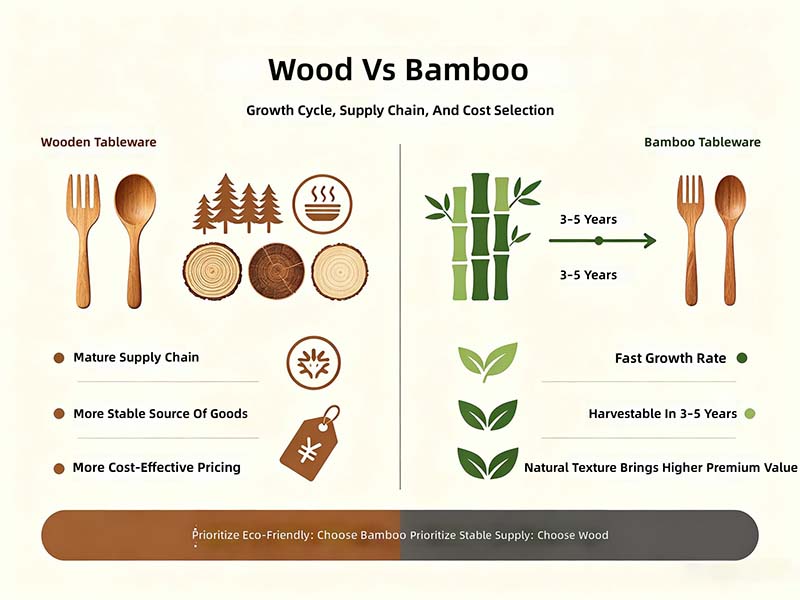
Wood vs Bamboo
The biggest advantage of bamboo is its growth rate - it can be harvested in three to five years. The production cycle is short. Bamboo cutlery has a natural sense of sophistication and differentiation, and brands are willing to pay for this premium; wooden cutlery, on the other hand, has the advantage of a mature supply chain, stable sources, and more cost-effective prices. If you care about the environmental data itself, bamboo is slightly better; if you care about cost and stable supply, wooden is more stable.
1.Check if the certification is complete
FSC (Forest Management Council Certification) is the first threshold. It confirms that the wood comes from responsibly managed forests, not from illegal logging. Then look at the PEFC certification. If you are supplying to the European or American markets or doing bulk purchases, you also need to pay attention to FDA food contact material certification, BRC, BSCI, SEDEX, etc. - these audits prove the compliance of the entire supply chain, not just the material itself. Check the certificates not just for the presence of them, remember to verify the certificate number, and you can check the authenticity on the official database.
2.Smoothness and burr condition
Take a sample and touch it directly, or use your lips to touch the edge - this is called the "lip test" in the industry. Good batches should be smooth, without prickly burrs and rough surfaces; poor batches, even if they look okay in appearance, can still be felt to have not been polished properly.
3.Whether there is an additional coating
Some products add a layer of food-grade coating to improve moisture resistance and smoothness. Make sure the coating is non-toxic and BPA-free.
4.Heat and moisture resistance performance
When holding hot soup or acidic foods (such as tomato sauce), will it deform or become soft? This is the key to determining whether it is suitable for catering scenarios. Wood is a porous material, more prone to absorbing moisture than plastic, so if the storage conditions are not right, it is easy to deform or even mold prematurely. It is best to ask the supplier about their recommended storage methods.
5.Is the strength sufficient?
For products like forks and knives that require force, conduct separate tests - will the fork break when inserting hard food, and can the knife really cut through things? If it is only for a soup spoon or stirring rod, this standard can be relaxed.
6.Packaging form
Bulk large packaging is cheaper and suitable for internal use or combined with your own packaging system; independent packaging (with tissues) is more suitable for scenarios where one-time distribution to customers is needed, such as for takeout or events, and the hygiene level is easier for consumers to trust.
For home daily use: prioritize hardwoods like oak or maple that are reusable, durable, easy to clean, and more cost-effective than always buying disposable ones over the long term.
For restaurant, cafe takeout/indoor dining: disposable cutlery made of poplar or birch is the mainstream. It balances cost and heat resistance, and is more hygienic when paired with independent packaging.
For celebration occasions like weddings and birthday parties: consider custom-made ones with prints or laser-engraved logos to enhance the presentation quality and align with the theme of environmentally friendly events.
Large-scale events such as exhibitions and music festivals: There is a large number of visitors and a wide variety of food options (including hot dishes and cold drinks). At this time, a combination of wood and bamboo can be used, and even CPLA can be used to handle foods that require forceful cutting. Do not rely solely on a single material to cover all scenarios.
If you are making bulk purchases for restaurants, companies, or events, the following experiences are worth considering:
1.Don't just compare prices. Different prices have different qualities, and you also need to consider the certification of wooden cutlery, customer reviews, and brand reputation.
2.You must get samples first. Testing heat resistance, smoothness, and whether there are burrs is more reliable than listening to what the supplier says.
3.Confirm that the order quantity matches your scale. Small stores do not need to rush to assemble tens of thousands of pieces just to get a low price.
4.Confirm the storage conditions. Wooden cutlery is afraid of moisture and high temperatures. If the warehouse environment is not up to standard, it is very likely that the goods will start to deform or even mold before they arrive. Clarify this responsibility in advance to avoid disputes when problems arise.
5.Confirm that the certification certificates are truly valid. Many suppliers will place certification logos on their promotional pages, but whether the actual certificate number can be found in official databases such as FSC, it is best to verify it yourself. Don't just believe the screenshots provided by the supplier.
One of the biggest selling points of wooden cutlery is "natural degradation", but there is a detail that is easily overlooked: Many products labeled "compostable" actually require industrial composting facilities to truly decompose. Throwing them into ordinary trash cans or your own garden compost pile will slow down the process significantly and may not achieve the desired effect. Purely natural, unprocessed wooden cutlery performs more stably in this regard, and can basically directly enter the household compost system without relying on industrial facilities. This is also the reason why many merchants emphasize "return to the soil" in their promotions. If there is a compost collection service in the local area, throwing them into the corresponding trash can is the most convenient way to handle them.
Is environmental protection equivalent to food safety?
Not completely. Environmental protection refers to the source of materials and degradation ability, while food safety refers to the absence of toxic substances and compliance with coating regulations. These are two different things. When buying, both aspects need to be confirmed. Don't think that just because it has a green label everything is fine.
Is wholesale necessarily more cost-effective than retail?
Not necessarily. While wholesale can indeed lower the unit price, the prerequisite is that your purchase volume can actually cover the minimum order quantity. Additionally, considering the costs of storage and capital occupation, small-scale users may not find it cost-effective. It's best to calculate your actual demand first and then make a decision.
Will wooden cutlery affect the taste of the food?
High-quality, minimally processed wooden cutlery generally does not have any unpleasant odors. Some people even think that the natural texture of wood can enhance the dining experience. However, if you buy cheap and poorly processed batches, there might be a smell of wood chips or glue, which is why the "test with a sample first" step cannot be omitted.
Can disposable wooden cutlery be reused?
Theoretically, it can be used for one or two times after being washed and dried, but the design concept and material thickness are all based on the one-time use standard. Repeated use over a long period is prone to cracking and deformation. If you really want to use it repeatedly, it's more convenient to buy the dedicated model made of hard wood.
Before choosing to purchase wooden cutlery, the following points should be noted:
1.Determine the purpose - whether it is for one-time use or long-term use, and the scenarios are for home use, dining, or events.
2.Verify the authenticity of the FSC and other certification numbers.
3.Test the smoothness, heat resistance, and strength of the samples.
4.Check if there are any additional coatings and whether it is BPA-free.
5.Calculate clearly whether retail or wholesale is more cost-effective based on the usage amount.
6.Ask in advance about the storage and degradation disposal methods.
Wooden cutlery is not necessarily the more expensive the better, nor is it guaranteed to be qualified just because it has the "eco-friendly" label. By going through these hard indicators, you can basically pick out a batch of cutlery that you can use with peace of mind and dispose of with ease.





